Back in October 2013, I published a short warning on my website with the title: “Don’t Turn On That Defroster!” I wrote it to warn drivers about a common but preventable problem: turning on the defroster on a cold morning and having an existing rock chip suddenly spread into a crack across the windshield.
Hearing that sudden snap from the glass is frustrating, particularly when the original damage had previously seemed small and quiet.
To be clear, this article is not a warning against normal defroster use on an undamaged windshield. Modern automotive safety glass is engineered to handle ordinary seasonal heating and cooling without issue. The danger arises when glass already has an existing rock chip, star break, or crack.
What Temperature Changes Do to Damaged Glass
Your vehicle's windshield is made of laminated safety glass: two curved sheets of glass bonded together by a tough, clear polyvinyl butyral (PVB) interlayer.
Like most solid materials, glass expands when it gets hot and contracts when it cools down. However, glass is also a relatively poor conductor of heat. When one section of a windshield heats up or cools down much faster than the surrounding glass, that localized temperature difference causes uneven expansion. Engineers refer to this as thermal stress.
On a sound, undamaged windshield, the glass distributes that stress evenly across its entire surface. But when a rock strikes the glass, it creates microscopic fracture lines and stress risers. The structural tension created by rapid temperature differences concentrates directly at the weakest points—the tips of those tiny fracture lines. When thermal stress overcomes the remaining strength of the damaged area, the break relieves the tension the only way it can: by snapping open and spreading.
Cold Mornings and Defroster Heat: Steve's Recommendations
On a cold morning in Riverside or the Inland Empire, your windshield glass may be down in the 40s or lower. When you start the vehicle and crank the defroster to maximum heat, the HVAC system directs hot air right at the base of that cold glass.
The inside surface directly over the vent nozzles heats and expands rapidly, while the surrounding and exterior glass remains cold. If an untreated rock chip sits anywhere in that heat path, the resulting thermal shock can cause it to crack across the windshield in seconds.
When a windshield already has an untreated rock chip or crack, I recommend both of the following precautions until you can have it professionally repaired:
- Start with low heat and low fan speed: Allow the glass temperature to rise gradually rather than hitting it immediately with maximum heat.
- Initially direct heated airflow away from the windshield: Aim the initial warm air toward the floor vents or instrument-panel cabin vents. Warming the cabin air first allows the interior temperature to rise evenly, tempering the windshield from the inside out without blasting concentrated heat at the damaged spot.
Never compromise safe driving visibility. California law and common sense require a clear view through your windshield before you drive. Do not attempt to drive with a fogged or frosted windshield. These recommendations are about how you bring the glass to a comfortable temperature gradually, not about driving with obstructed vision.
Hot Afternoons, Air Conditioning, and Cold Water
While winter defrosters get most of the attention, hot weather also deserves care. Here in Riverside and surrounding Inland Empire communities, summer sun can heat a parked vehicle's windshield significantly.
When a windshield is already damaged, sudden temperature changes in hot weather can create thermal stress:
- Directing strong air conditioning onto a hot windshield: Getting into a sun-heated car and immediately directing very cold air onto the windshield can create thermal stress that may cause existing damage to spread. While it does not happen in every instance, rapid cooling creates uneven tension across damaged glass.
- Applying cold water to sun-baked glass: In nearly four decades of repairing windshields, I have personally seen existing damage spread when cold water was applied to hot glass. Washing a hot vehicle with cold hose water or taking a sun-heated vehicle through a cold wash can subject an existing chip or crack to an abrupt temperature drop.
When your windshield has existing damage during hot weather, avoid abrupt temperature shifts. Park in the shade when possible, ventilate a parked, sun-heated vehicle before driving to allow extreme heat to dissipate naturally, and avoid spraying cold water onto hot, damaged glass before having it repaired.
Why Damage Near the Bottom of the Windshield Deserves Attention
Rock chips located near the bottom of the windshield—near the wiper blades and defroster vents—deserve prompt attention because of their close proximity to dashboard defroster ducts. Whenever the defroster runs, that lower section of the glass experiences the most concentrated temperature changes.
Damage extending into the black ceramic border (the frit band) near the edge of the glass does not automatically prevent repair. While some shops establish rigid rules against repairing edge damage, repairability depends on the specific characteristics of the break. I evaluate each break individually to determine whether an effective repair can be achieved.
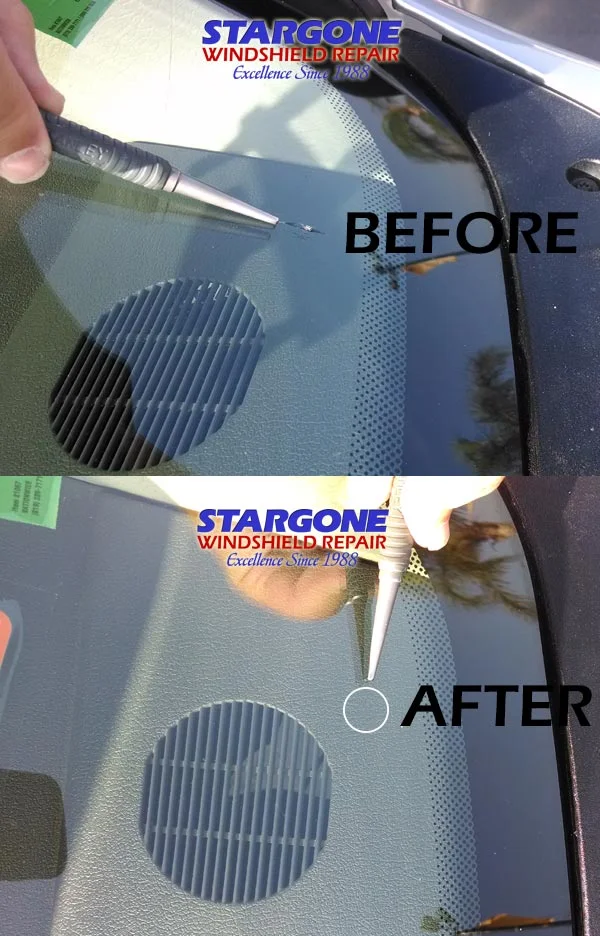
The photograph above illustrates an actual repair I completed on a vehicle in Riverside. Notice the position of the rock chip: it was located right against the black dot-matrix border and directly over the defroster vent grille. Had this driver run full defroster heat on a cold morning before getting it repaired, this chip could have spread rapidly.
What Happens If the Chip Becomes a Crack?
In my original 2013 article, I stated that once a crack spreads, the windshield can no longer be repaired and must be replaced. With the tools, techniques, and specialized resins I use today, that is no longer the whole story.
While Stargone specializes exclusively in windshield repair and does not replace windshields, I can repair certain single cracks up to 24 inches long, depending on their characteristics, location, and how clean the crack has remained.
A chip spreading into a crack does not automatically mean you are forced into an expensive windshield replacement.
However, getting the chip repaired before it spreads remains by far the best option for your wallet and your vehicle:
- A chip repair starts at $89.95 (with additional chips on the same glass at just $25 each) and is typically completed in 15 to 30 minutes once work begins.
- A long crack repair starts at $150, requires a more involved injection process, and takes longer to complete.
- Spreading damage carries replacement risk: If a crack continues to spread until it reaches multiple outer edges, develops multiple branching legs, or becomes contaminated with road dirt, moisture, and washer fluid, it can eventually become unrepairable. At that point, full windshield replacement—often costing several hundred to over a thousand dollars—becomes the only option.
Repairing a chip early preserves your vehicle's factory-installed windshield seal, maintains the original glass, and saves you money. For more guidance on choosing a service provider, read my guide on 7 Questions to Ask Before Calling a Windshield Repair Company and review my services and pricing.
Practical Steps and Contacting Stargone
If a flying rock or road debris has chipped your windshield, taking a few simple precautions will help keep the damage from running until I can repair it:
- Avoid sudden temperature shocks: Use gradual heat and A/C settings, and avoid washing a sun-baked windshield with cold hose water.
- Keep moisture and dirt out: Avoid taking the vehicle through a car wash, and do not wash the windshield with soaps or chemicals before the repair. A dry, clean break yields the cleanest cosmetic result.
- Schedule the repair promptly: Road vibration from bumps, potholes, and door slams adds mechanical stress on top of thermal stress. Getting the chip repaired early prevents the original damage from spreading.
Every repair at Stargone is personally performed by me, Steve Webb. I bring 38 years of hands-on experience to every job, providing mobile service directly to your home or workplace throughout Riverside and surrounding communities within approximately 20 miles.
Once I complete a repair, my work is backed by a straightforward promise: I guarantee that the original repaired damage will never spread. If the original repaired damage ever does spread, you can choose between a re-repair, when technically possible, or a refund of 100% of the original repair cost. This guarantee applies for as long as that windshield remains installed in your vehicle and excludes new impacts or unrelated damage.